![]() |
| Establishment | Flora and Fauna | Geology |
| Native American History | Red Rock Eden | Size and Visitation |
Establishment
Capitol Reef National Park was established 02 Aug 1937 as a national monument by President Franklin D. Roosevelt. It was redesignated a national park in 1971 and increased six times its original size to protect the majority of the Waterpocket Fold.
The legislation - "An Act to Establish The Capitol Reef National park in the State of Utah" - became Public Law 92-207 when it was signed by President Nixon on December 18, 1971.
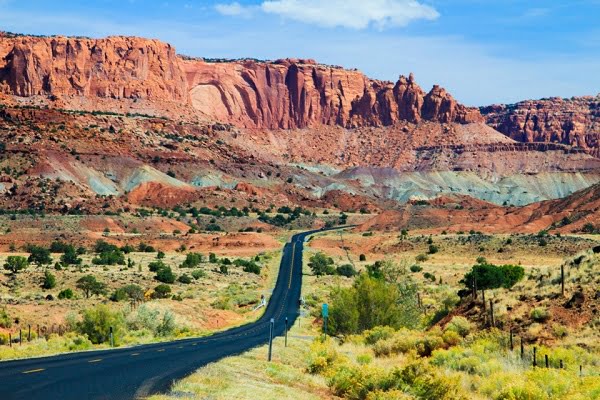
Called "Wayne Wonderland" in the 1920s by local boosters Ephraim P. Pectol and Joseph S. Hickman, Capitol Reef National Park comprises 378 square miles of colorful canyons, ridges, buttes, and monoliths. About 75 miles of the long up-thrust called the "Waterpocket Fold", extending like a rugged spine from Thousand Lake Plateau southward to Lake Powell, is preserved within the park boundary. "Capitol Reef" is the name of an especially rugged and spectacular park of the Waterpocket Fold near the Fremont River.
Early History
Only a few decades ago, Capitol Reef and the Waterpocket Fold country comprised one of the remote corners of the "lower 48". Easy road access came only with the construction of a paved Utah Hwy 24 through the Fremont River Canyon in 1962.
The earliest traces of human activity date from the 9th century when Indian peoples occupied the flood plains and high ground near the few perennial watercourses. These people - called the Fremont Culture by archeologists - were contemporaries of the pueblo-building Anasazi of the Four Corners area but were less advanced. In the 13th century, all Indian cultures in this area underwent sudden change; the Fremont Indian settlements and fields were abandoned. No one is sure what happened to these Fremont hunter-farmers.
Not for several centuries did significant human activity reappear. When the first white explorers traveled in the vicinity of the Waterpocket Fold, both Utes and Southern Paiute nomads were encountered.
Despite the fact that numerous expeditions passed near Capitol Reef, none of them explored the Waterpocket Fold to any great extent. It was, as now, incredibly rugged and forbidding.
Following the Civil War, Mormon church officials at Salt Lake City sought to establish "missions" in the remotest niches of the intermountain west. In 1866, a quasi-military expedition or Mormons in pursuit of marauding Indians penetrated the high valleys to the west. In the 1870s, settlers moved into these valleys, eventually establishing Loa, Fremont, Lyman, Bicknell, and Torrey. Meanwhile, men from the expeditions of Major John Wesley Powell had begun to explore the area.
In the early 1880s, settlers moved into Capitol Reef country. Tiny communities sprung up along the life-sustaining Fremont River; Junction (later "Fruita"), Caineville and Aldridge were created. Fruita prospered, Caineville barely survived, Aldridge died.
By 1920, the work was hard but the life in Fruita was good. No more than ten families at one time were sustained by the fertile flood plain of the Fremont River and the land changed ownership over the years. The area remained isolated.
The "Father of Capital Reef National Monument"
Ephraim Portman Pectol was born in 1875. As a child he lived in Caineville, another abortive Mormon settlement 20 miles east to Capitol Reef. In 1910, he went into business in Torrey and operated a store there for many years. He served as Mormon Bishop of Torrey from 1911 until 1928.
Pectol was sensitive to the rugged beauty of the Capitol Reef area and was an avid Fremont culture relic hunter. A private museum in his Torrey store was widely known.
Pectol was anxious that the "outside world" should come to appreciate the beauty of the area. In 1921, he organized a "Boosters Club" in Torrey. Pectol pressed a promotional campaign, furnishing stories and photos to periodicals and newspapers. In his efforts, he was increasingly aided by his brother-in-law, Joseph S. Hickman, who was Wayne County High School principal.
In 1924, Hickman extended community involvement in the promotional effort by organizing a Wayne County-wide "Wayne Wonderland Club". In 1924, the educator was elected to the Utah State Legislature.
Pectol was elected to the presidency of the "Associated Civics Club of Southern Utah", successor to the Wayne Wonderland Club. The club raised $150.00 to interest a Salt Lake City photographer in taking a series of promotional photos. For several years, the photographer - J.E. Broaddus - traveled and lectured on "Wayne Wonderland".
In 1933, Pectol himself was elected to the legislature and almost immediately contacted President Roosevelt and asked for the creation of "Wayne Wonderland National Monument" out of the federal lands comprising the bulk of the Capitol Reef area. Federal agencies began a feasibility study and boundary assessment. Meanwhile, Pectol not only guided the government investigators on numerous trips, but escorted an increasing number of visitors. The lectures of Broaddus were having an effect.
On August 2, 1937, President Roosevelt signed a proclamation creating Capitol Reef National Monument.
In Proclamation 2246, President Roosevelt set aside 37,711 acres of the Capitol Reef area. This comprised an area extending about two miles north of present Utah Hwy 24 and about 10 miles south, just past Capitol Gorge. More highly protective federal regulations now applied in "Wayne Wonderland".
These Depression years were lean ones for the National Park Service (NPS), the new administering agency. Funds for the administration of Capitol Reef were nonexistent; it would be a long time before the first rangers would arrive.
Charles Kelley was a man of diverse interests and great talent. Born in 1889, "Charlie" made his living as a linotype operator and printer. As he matured, a talent for writing, as well as printing, emerged.
Moving to Salt Lake City in 1919, Kelly began a love affair with the deserts and canyons of Utah that would last a lifetime. He concentrated his exploration energies on southern Utah and the Colorado River area. His interest in arch-ecology, as well as more recent history, grew.
He published his first book in 1930 - Salt Desert Trails. Five more books followed, the most well-known being Outlaw Trail, the story of Butch Cassidy. Scores of his articles were published by Deseret Magazine, The Utah Historical Quarterly, and The Saturday Evening Post.
Kelly developed an intense interest in Fremont and Anasazi rock art. On several of his trips, he passed through Fruita and came to know a colorful resident, Dr. Arthur L. Inglesby, a dentist retired from practice. "Doc" Inglesby was an avid rockhound who had come to know Capitol Reef intimately.
Inglesby and Kelly became friends and made numerous trips into the rugged butte and canyon country around Fruita. Kelly decided that he, too, would retire in Fruita.
Meanwhile, not much was happening with the administration of Capitol Reef National Monument, which had been placed under the control of Zion National Park. However, a stone ranger cabin and the Sulphur Creek bridge were built and some road work was performed by the CCC (Civilian Conservation Corps) and the WPA (Works Project Administration). Kelly came to know NPS officials at Zion well and volunteered to "watchdog" the park for the NPS. In 1943, he was officially appointed "custodian-without-pay".
Charles Kelly's retirement had been short. He was to work without pay as a volunteer until 1950 when the NPS offered him a civil service appointment as the first superintendent. At age 62, he got his first federal job at an age when most career NPS people have already retired.
Life was challenging for Kelly; he continued to write - mostly about Capitol Reef. During the 1950s, he was deeply troubled by NPS management acceding to demands of the Atomic Energy Commission that Capitol Reef National Monument be opened to uranium prospecting. He felt that the decision had been a mistake and destructive of the long term national interest. As it turned out, there was not enough ore to be worth mining in the monument.
It was not until 1958 that Kelly got additional permanent help in protecting the monument and enforcing regulations; Park Ranger Grant Clark transferred from Zion. The year Clark arrived, fifty-six thousand visitors came to the park and "Charlie" Kelly retired for the last time, full of years and experiences.
During the 1960s (under the program name "Mission 66"), NPS areas nationwide received new facilities to meet the demand of mushrooming park visitation . At Capitol Reef, a 53-site campground at Fruita, staff rental housing, and a new visitor center were built, the latter opening in 1966.
Visitation climbed dramatically after the paved, all-weather road was built through the Fremont River canyon near Fruita and the old Capitol Gorge road closed. In 1967, 146,598 persons visited the park. The staff was also growing.
During the 1960s, the NPS proceeded to purchase private land parcels at Fruita and Pleasant Creek. Almost all private property passed into public ownership on a "willing buyer-willing seller" basis.
Preservationists successfully convinced President Johnson to set aside an enormous area of public lands in 1968, just before he left office. In Presidential Proclamation 3888, an additional 215,056 acres were placed under NPS control. By 1970, Capitol Reef National Monument comprised 254,251 acres and sprawled southeast from Thousand Lake Mountain almost to the Colorado River. The action was very controversial locally, and NPS staffing at the monument was inadequate to properly manage the additional land.
The vast enlargement of the monument and diversification of the scenic resources soon raised another issue: Whether or not Capitol Reef should be a national park, rather than a monument. Two bills were introduced into Congress.
A House bill (H.R. 17152) introduced by Utah Congressman Laurence J. Burton, called for an 180 thousand acre national park and an adjunct 48 thousand acre national recreation area where "multiple use" (including grazing) could continue indefinitely.
In the Senate, meanwhile, Senate bill S. 531 had already passed on July 1, 1970 as provided for a 230 thousand acre national park alone. The bill called for a 25 year phase-out of grazing.
In September 1970, Department of interior officials told a house subcommittee session that they preferred that about 254 thousand acres be set aside as a national park. Also, they recommended that the grazing phase-out period be 10 years, rather than 25. They did not favor the adjunct recreation area concept.
It was not until late 1971 that Congressional action was completed. By then, the 92nd Congress was in session and S. 531 had languished. A new bill, S. 29, was introduced in the Senate by Senator Frank M. Moss of Utah and was essentially the same as the defunct S. 531 except that it called for an additional 10,834 acres of public lands for a Capitol Reef National Park. In the House, Utah Representative Gunn McKay (with Representative Lloyd) had introduced H.R. 9053 to replace the dead H.R. 17152. This time around, the House bill dropped the concept of an adjunct Capitol Reef National Recreation Area and adopted the Senate concept of a 25 year limit on continued grazing.
The Department of Interior was still recommending a national park of 254,368 acres and a 10 year limit for grazing phase-out.
S. 29 passed the Senate in June and was sent to the House. The House subsequently dropped its own bill and passed the Senate version with an amendment. Since the Senate was not in agreement with the House amendment, differences were worked out in Conference Committee. The Conference Committee issued their agreeing report on November 30, 1971.
The legislation - "An Act to Establish The Capitol Reef National park in the State of Utah" - became Public Law 92-207 when it was signed by President Nixon on December 18, 1971.
Size and Visitation
Capitol Reef National Park has 241,904 acres, or 378 square miles. Capitol Reef ranges from 8,255 feet in Upper Cathedral Valley to 3,967 feet in Halls Creek and is located in the heart of "Canyon Country" along Utah Highway 24 (U-24), halfway between Canyonlands and Bryce Canyon National Parks.
The majority of park visitors come during May to September and are lowest in December through February.
Native American History
Human use of this area dates back at least 10,000 years, but the Waterpocket Fold is best known for its Fremont and Anasazi (Ancestral Puebloan) Native American occupations. The area was also used by Paiute, Ute and perhaps Navajo people until it was settled by Mormon pioneers in the 1880's.
The Fremont Culture
The Fremont people lived throughout Utah and adjacent areas of Idaho, Colorado and Nevada from 700 to 1300 AD. The culture was named for the Fremont River and its valley in which many of the first Fremont sites were discovered.
The Fremont were a Puebloid group who had strong cultural affiliations with their better-known contemporaries, the Anasazi. While the Anasazi built cliff dwellings, the Fremont often lived in pit houses (dug into the ground and covered with a brush roof), wickiups (brush and log huts) and natural rockshelters. Their social structure was composed of small, loosely organized bands consisting of several families. They were closely tied to nature and were flexible, diverse and adaptive -- often making changes in their life ways as social or environmental changes occurred.
Diet
The Fremont maintained a hunting and gathering lifestyle and supplemented their diet by farming; growing corn, beans and squash along the river bottoms. Edible native plants included pinyon nuts, rice grass and a variety of berries, nuts, bulbs, and tubers. Corn was ground into meal on a stone surface (metate) using a hand-held grinding stone (mano.) Food was stored in pottery jars or baskets inside small masonry structures, called granaries, which were tucked under small overhangs on narrow ledges. Deer, bighorn sheep, rabbits, birds, fish and rodents were hunted using snares, nets, fishhooks, bow and arrow, and the atlatl or throwing stick.
Unique Artifacts
Archeologists have identified several kinds of artifacts that are distinctive to the Fremont people. One was a singular style of basketry, called one-rod-and-bundle, which incorporated willow, yucca, milkweed, and other native fibers. They also created pottery, mostly graywares, with smooth, polished surfaces or corrugated designs pinched into the clay.
Unlike the Anasazi who wore yucca fiber sandals, the Fremont made moccasins from the hide of large animals, such as deer, with the dew claw placed on the sole to act as a hobnail; providing extra traction on slippery surfaces.
The most unique and mysterious artifacts left by the Fremont were clay figurines. The small figures resemble people, often showing intricate details such as ear bobs, necklaces, clothing, hair and facial decorations and sexual characteristics. The purpose of figurines is unknown, but it is believed they had magical or religious significance.
Rock Art
Figurines resemble Fremont rock art. Pictographs (painted) and petroglyphs (carved or pecked) are depictions of people, animals and other shapes and forms left on rock surfaces. Anthropomorphic (human-like) figures usually have trapezoidal shaped bodies with arms, legs and fingers. The figures are often elaborately decorated with headdresses, ear bobs, necklaces, clothing items and facial expressions. A wide variety of zoomorphic (animal-like) figures include bighorn sheep, deer, dogs, birds, snakes and lizards. Abstract designs, geometric shapes and handprints are also common.
The meaning of rock art is unknown. The designs may have recorded religious or mythological events, migrations, hunting trips, resource locations, travel routes, celestial information and other important knowledge. Many believe rock art uses symbolic concepts that provide the observer with information and that it was important, not simply artistic expression or doodling. Some day, we may understand rock art better, but only if these sites are not destroyed. The slightest touch removes fine granules of sand and leaves behind a residue of sweat and oil. Please refrain from any activity that involves touching the panels. If you see anyone damaging rock art or any archeological site, report it to a ranger immediately.
By 1300 AD, the Fremont had abandoned their villages. No one is completely sure why they left or what happened to them. One common thought is that changing weather conditions caused a severe drought in the southwest that lasted over 30 years. Such conditions would have forced the Fremont to adopt a nomadic lifestyle as they abandoned farming and relied completely on hunting and gathering for food. This, combined with diseases, may have eventually caused them to die off. Like the Anasazi, their disappearance was quick and dramatic and continues to puzzle archeologists today.
Red Rock Eden: The Story of Fruita and the Orchards
Visitors to Capitol Reef National park are often curious about the fruit trees that lie within a mile or two of the Visitor Center. These trees - apple, pear, peach, cherry, apricot, mulberry, even Potowatomee Plum - are the most obvious reminder of the pioneer community that once prospered in the narrow valley of the Fremont River.
Settlement came late to south-central Utah; the Capitol Reef area wasn't charted by credible explorers until 1872. In the last half of that decade, Latter Day Saints (Mormon) settlers moved into the high plateau lands west of Capitol Reef and established communities based on short-season farming and grazing. They then looked to the east, along the corridor of water snaking through the soaring cliffs and domes of the Waterpocket Fold - the Fremont River.
The origin of the little community at the junction of the Fremont River and Sulphur Creek is obscure. The first "resident" may have been an 1879 squatter by the name of Franklin Young, but the first landholder of record was Niels Johnson. Other soon followed, and the community that sprang up became known as "Junction".
The Fremont River was the key to life; without irrigation, farming would have been impossible. Unlike some of the other small settlements that grew up further down river - Aldrich, Caineville, Blue Valley - Junction was usually spared the more extreme devastation caused down river by frequent flooding. The orchards of her residents prospered and before the turn of the century Junction was know as "the Eden of Wayne County". In 1902, the name of the little settlement was changed to "Fruita".
The settlement never incorporated. Local authority - such as it was - was vested in the Mormon "Presiding Elder". The population averaged about 10 families.
Although it became widely known in south-central Utah for its orchards, Fruita residents also grew sorghum (for syrup and molasses), vegetables and alfalfa. Fruit growers usually picked the fruit prior to maturation and hauled it by the wagon load to bigger towns like Price and Richfield - and beyond. This was a formidable undertaking when one considers that in 1901 it took the Mormon Bishop of Torrey more than an hour and a half to travel the ten miles between Fruita and Torrey in the best weather. If the road between Torrey and Fruita was difficult, the "road" between Fruita and Hanksville - 37 miles east - was nearly impossible.
In 1884, residents of Fruita (then Junction) had built a passage through Capitol Gorge that extended to Caineville and Hanksville. This primitive roadway was called the "Blue Dugway" and it served to connect the river settlements with the rest of Utah until after World War II. This narrow wagon track was so difficult, however, that the little communities remained some of the most isolated in American until the mid-20th century.
Along the Fremont River, barter served as the means for acquiring goods and services; cash was in short supply. Although some Fruita men worked on state roads, annual fruit sales remained the major sources of cash income.
The one-room schoolhouse, constructed by residents in 1896, also served as a community center. The desks were movable and the community enjoyed dances and box socials in the little building. Residents also held church activities there, as well as in private homes. Women often quilted together and men and boys were especially fond of baseball. "Putting up" foods was not a hobby in Fruita; it was essential for survival through the winter.
Well into the modern era, farming techniques in Fruita remained in the 19th century. It was not until World War II that the first tractor was purchased.
Fifty years ago, Fruita was spared much of the anguish that the Great Depression brought to other communities in America. Long reliance on barter as the main method of obtaining basic life needs shielded the Fremont River settlers from the cash drought that plagued the nation. Contrary to what one might imagine, Fruita sheltered passionate supporters of Franklin D. Roosevelt as well as more conservative "Hooverites".
Although it wasn't recognized at the time, the establishment of Capitol Reef National Monument in 1937 would become a tolling bell for the Fruita community. After World War II, visitors began to arrive in increasing numbers; the road from Richfield to Torrey was paved in 1940. In 1952, the pavement was extended to Fruita; the world had found the Capitol Reef country.
As visitation to the monument increased in the post war years, the National Park Service (NPS) determined to purchase all the Fruita property still in private hands. By the late 1960s most of this had been accomplished on a "willing seller/willing buyer" basis. Many of the residents structures and outbuildings were razed.
Although most of the structures of the Fruita settlement are gone (with the exception of the restored schoolhouse, the Gifford house and barn, and a few others), the orchards remain and dominate the landscape. The new general management plan for Capitol Reef National Park cites the value of the orchards as a "historic landscape" and affirms the resolve of the NPS to preserve them.
The orchards - all owned by the National Park Service - are maintained at a level of about 2,500 trees with 1,800 in production. A small crew is kept busy year-round with pruning, irrigation, replanting, and spraying.
As each fruit crop comes into season, the fruit is made available to the public on a pick-your-own basis. The park Superintendent sets the per pound or bushel price after checking local commercial orchard prices. Although he may take the isolation of Fruita into consideration in setting prices, he is not permitted to undercut private enterprise.
Management of the orchards, especially during picking season, presents some difficult problems to resolve. Because the trees were planted in smallish family orchards originally - each with a wide variety of fruit - fruit ripens in many "mini-orchards" at varying times. It is very difficult for park rangers to "open" orchards for picking in small "penny packets" and still exercise the control needed to protect the trees from damage and pickers from unsafe acts.
However, as the trees become overage, horticultural workers are slowly replacing the patchwork quilt-like layout of the orchards with a more orderly arrangement consisting of large tracts of monocultures, e.g., all peaches in one large orchard, all apricots in another large orchard, etc. In this way, the gross aspect of the "historic landscape" will be maintained but the fruit harvest will be much easier to manage.
Fruita Schoolhouse - Readin', Ritin', & 'Rithmetic
The sound echoes off the sheer, red Wingate sandstone walls that crowd the narrow Fremont River Valley as 14-year old Nettie Behunin rings the old bell to start school The echo is answered by the shouts and laughter of the children as they run toward the new one-room Fruita School. Early morning chores need to be done before school starts. Two children dip the old barrel in Sulfur Creek to collect the day's drinking water. Other children bring in fruit wood for the old potbellied stove and another child raises the 44-star flag. The year is 1900.
Classes had been going on for two years before this building was constructed as the community wasted little time getting a school started. Nettie, the daughter of Elijah Cutler Behunin, one of the first settlers, had previously taught the children in the Behunin home.
In 1896, Elijah donated land for a school building that he and other early Junction settlers built. Even though only eight families lived in Junction, these farmers had large families. The Behunins raised 13 children. Nettie's first class had 22 students, three of whom were her siblings: two brothers, 7 and 12, and a sister, 10.
In 1880, Nels Johnson became the first homesteader in the lush Fremont River valley. He built his home near the confluence of Sulphur Creek and the Fremont River. Soon, other Mormon settlers followed, establishing small farms and orchards near the confluence, creating the village of Junction, Utah. The name was changed to Fruita in 1902, and the site is now part of Capitol Reef National Park.
Originally, there was a flat, dirt covered roof on the school. A peaked, shingled roof was added in 1912 or 1913. The interior walls, originally bare and chinked logs, were plastered in 1935.
The first desks were homemade, constructed of pine, and seated two students each. These were sometimes used to quiet unruly students. The teacher would seat a troublesome boy with a girl, and the resulting blow to his ego would often bring him under control.
Teachers taught the "three-Rs" to the eight grades at the school. If the teachers felt qualified and had enough textbooks, other subjects such as geography, were added.
The students were full of pranks. To delay the start of class, they often hid the teacher's alarm clock in the woodpile. Kerosene for lanterns used during night meetings were stored in the school, and a few enterprising students found that dropping a small piece of calcium carbide, taken from a lantern, into an inkwell would cause it to overflow. If the inkwell was tightly capped, it would explode and spatter ink all over the room.
The log building also served as a community meeting house and church. Desks were not bolted to the floor, so the room could be cleared for different needs. As late as 1924, the building was also used for dances, town meetings, elections, church youth activities, box suppers, and celebrations.
In 1900, the building was loaned to the Wayne County School District for the first county approved classes. Nettie, then 22, was the first authorized teacher. She was paid $70 a month while her male counterparts received $80 per month. Classes, of varying sizes, continued until 1941 when the school was discontinued for lack of students.
In 1964, the National Park Service nominated the school to the National Register of Historic Places and subsequently restored the structure to the 1930s period. Today, the school stands alongside Utah Hwy 24. Visitors can hear a recorded message by one of the teachers at the old school. They may also peer through the windows into the furnished structure and imagine what school was like, so long ago. Those with a good imagination can still hear that old school bell ring.
Flora and Fauna
Flora
The spring months of April, May and early June are magnificent as the cherry, plum, apricot, pear and apple trees are in bloom. Fremont cottonwood, exotic tamarisk, single leaf ash and many other trees are also becoming green again. Spring is the time for many wildflower displays. The moisture provided by the Fremont River assures the local area of many species of flowers such as the legumes (vetches, locos, and the beautiful blue lupine), and penstemons (firecracker, low and Palmer) common to most western areas.
Even the more arid parts of Capital Reef produce a certain number of desert wildflowers. Two of these moisture conserving plants are the many species of cacti, and the Fremont barberry or "algerita", whose foliage is motified into small holly like leaves which prevent moisture. Prickly pear cactus does well on the dry hillsides. The roots of the sego lilly were a food source for Native Americans.
Capital Reef lies basically in the Upper Sonoran life zone; its higher elevations lie nearly in the Transition or "ponderosa" zone. The dominant trees here are the pinyon and junipers which make up the "Pygmy Forest".
Approximately 900 species of plants live within park boundaries. Capitol Reef has the highest concentrations of threatened or endangered plants of Utah's national parks.
Fauna
With the coming of spring, wildlife becomes active again. The abundant moisture provided by the Fremont River attracts a large variety of birds. The leafing out of the trees lure back the many species of warblers, northern origole, black headed and evening grosbeaks, the shy catbirds and the even shyer yellow breasted chat (which can be heard day and night, but can seldom be seen), and many more.
Commonly seen on the desert are the mocking bird and the sage thrasher, and swooping down from the high cliffs and the white throated swift and many species of swallows. Golden Eagles nest on the high Wingate ledges. Hundreds of mountain and western bluebirds migrate through the area on their way to nesting sitres in the higher country to the west of Capitol Reef.
Although summer is hot and the weather unpredictable, it is the best time to view wildlife. Newborn fawns and their mothers are easily seen in the orchards and surrounding hills Yellowbellied marmots can be seen sunning themselves on the rocks and rock squirrels can be seen hurring across the roads, carrying food to their dens. The smaller chipmunks and antelope ground squirrels can be seen scampering around as well. Although the beaver are not common, occasionally they can be found working along the Fremont River. Their main food source here is the cottonwoods and willows.
Reptils are most active during the summer. Many kids of lizards are scurrying around or basking on rocks in the sun. The most common are the long western whiptails, the eastern fence lizard and the side blotched lizards. Water snakes are common along the river, while gopher snakes and racers hunt mice and rodents.
Two types of poisonous snakes are found in Capital Reef. Both of these should be respectfully treated. They are both a variety of the prairie rattlesnake: the small midget rattlesnake, only 12 to 18 inches long and the larger Great Basin rattlesnake, 20 to 24 inches long. Neither a large snakes but both can be dangerous if teased or cornered. Give them plenty of space and they will avoid humans if given a chance.
Many of the animals can be seen by day, but most are nocturnal, traveling or hunting at night. Bobcats hunt for black tailed jackrabbits. The occasional cougar prowls the canyons and ledges and a ring tailed cat (a member of the raccoon family) has eyes that are so sensitive that it is virtually impossible for him to come out of his den during the daylight, hunt at night.
Two species of fox live in the area, the gray fox is found in the vicinity if the Fremont River, and the little kit fox is a desert resident. Both are beneficial in keeping the rodent population down. The coyote is seen occasionally seen in the area although that is quite rare.
Many species of bats and the common nighthawk jointly help control the thousands of insects attracted to the moisture of the river. Over 315 genera or animals ranging from seldom-seen desert bighorn sheep and cougar to common mule deer and yellow-bellied marmots.
Geology
The Waterpocket Fold defines Capitol Reef National Park. A nearly 100-mile long warp in the Earth's crust, the Waterpocket Fold is a classic monocline: a regional fold with one very steep side in an area of otherwise nearly horizontal layers. A monocline is a "step-up" in the rock layers. The rock layers on the west side of the Waterpocket Fold have been lifted more than 7000 feet higher than the layers on the east. Major folds are almost always associated with underlying faults. The Waterpocket Fold formed between 50 and 70 million years ago when a major mountain building event in western North America, the Laramide Orogeny, reactivated an ancient buried fault. When the fault moved, the overlying rock layers were draped above the fault and formed a monocline.
More recent uplift of the entire Colorado Plateau and the resulting erosion has exposed this fold at the surface only within the last 15 to 20 million years. The name Waterpocket Fold reflects this ongoing erosion of the rock layers. "Waterpockets" are basins that form in many of the sandstone layers as they are eroded by water. These basins are common throughout the fold, thus giving it the name "Waterpocket Fold". Erosion of the tilted rock layers continues today forming colorful cliffs, massive domes, soaring spires, stark monoliths, twisting canyons, and graceful arches.
The most scenic portion of the Waterpocket Fold, found near the Fremont River, is known as Capitol Reef: "capitol" for the white domes of Navajo Sandstone that resemble capitol building rotundas, and "reef" for the rocky cliffs which are a barrier to travel, like a coral reef.
Nearly 10,000 feet of sedimentary strata are found in the Capitol Reef area. These rocks range in age from Permian (as old as 270 million years old) to Cretaceous (as young as 80 million years old.) The Waterpocket Fold has tilted this geologic layercake down to the east. The older rocks are found in the western part of the park, and the younger rocks are found near the east boundary. This layer upon layer sequence of sedimentary rock records nearly 200 million years of geologic history. Rock layers in Capitol Reef reveal ancient climates as varied as rivers and swamps (Chinle Formation), Sahara-like deserts (Navajo Sandstone), and shallow ocean (Mancos Shale).
The tilt of the Waterpocket Fold dies out at Thousand Lake Mountain near the northwestern boundary of the park. Rock layers in Cathedral Valley have a gentle inclination of 3 - 5 degrees to the east and appear nearly horizontal. Deep erosion has carved Cathedral Valley's free-standing monoliths, or temples, out of the soft reddish-orange Entrada Sandstone, which was originally deposited as sandy mud on a tidal flat. Some of the cathedrals are capped by thin, hard beds of a greenish gray marine sandstone, the Curtis Formation.
The scenery of the Entrada Sandstone temples of Cathedral Valley is complemented by evidence of other geologic processes at work. Flowage and dissolution of gypsum, a soluble mineral from the underlying Carmel Formation, created Glass Mountain and the Gypsum Sinkhole. Glass Mountain is an exposed plug of gypsum. The Gypsum Sinkhole formed when a gypsum plug dissolved. Dikes and sills, which are thin bodies of igneous rock and small volcanic plugs, are found in Upper Cathedral Valley. These features formed during volcanic activity 3 to 6 million years ago.
Erosion
Most of the erosion that carved today's landscape occurred after the uplift of the Colorado Plateau sometime within the last 20 million years. Most of the major canyon cutting probably occurred between 1 and 6 million years ago.
Even in this desert climate, water is the erosional agent most responsible for the carving of the landscape. The pull of gravity, in the form of rock falls or rock creep, plays a major role in the shaping of the cliff lines. Wind is a minor agent of erosion here.
The landforms are a result of different responses of the various rock layers to the forces of erosion. Hard sandstone layers, like the red Wingate and the white Navajo Sandstones, form cliffs. Softer, shale layers, like the Chinle Formation, form slopes and low hills. The barren slopes found in many areas are due in part to the presence of bentonitic clays in the shale which make an inhospitable environment for plants.
The black boulders, found scattered throughout the Fremont River valley and along other drainages, are recent geologic arrivals to Capitol Reef. These volcanic rocks came from the 20 to 30 million year old lava flows which cap Boulder and Thousand Lake Mountains. The boulders made their way to Capitol Reef during the Ice Ages when the High Plateaus supported small mountain glaciers. Landslides, debris flows, and possibly heavy stream outwash from these glaciers carried the boulders to lower elevations in the park.
Capitol Reef National Park was established because of the scenic rock domes and narrow canyons found along the trace of the Waterpocket Fold. Indeed, the park boundaries were drawn to encompass most of the Fold. Capitol Reef is a place to enjoy the scenic majesty formed by geologic processes, and also to appreciate the interrelationships between the Earth and all life found in the varied environments within the park - - from the forested slopes of Thousand Lake Mountain, to the green oasis of Fruita, to the barren Bentonite Hills.
The Capitol Reef area was called the “Land of the Sleeping Rainbow” by the Navajo because of the brilliantly colored canyon walls. The rocks of Capitol Reef are mostly sedimentary rocks which are a drab off-white color unless the rocks contain small amounts of impurities which act as pigments. Iron (“Nature’s Paintbrush”) in its various chemical states is the most common coloring agent found in rocks.
Common Rock Colors
Red to reddish brown to purplish rocks contain hematite (ocher) which is simply rust or iron oxide (Fe2O3). Less than half of a percent by weight of hematite is enough to color a rock brilliantly red. Red rocks were deposited under oxidizing conditions.
Yellowish to orangish to rusty brown rocks are colored by limonite (rust containing water: FeO OH nH2O). Limonite forms under oxidizing and hydrating conditions such as in well-drained nonmarine or transitional environments that are barren of vegetation. Geothite, which is a mineral similar to limonite, forms brown concretions in some sandstone layers such as in the Navajo Sandstone.
Light blue, greenish gray, and off-white rocks show the true colors of the sedimentary particles themselves. These persist in environments with neutral to slightly reducing conditions.
Dark green rocks contain minerals which contain reduced (ferrous) iron, and were deposited in stagnant marine basins, swamps, bogs, and lakes.
Dark gray, brownish gray to black rocks contain incompletely decomposed organic matter which is preserved under reducing conditions such as in stagnant marine basins.
Bright white rocks may consist of the mineral gypsum (CaSO4 2H2O) which is an evaporite mineral found in some rock layers including the Moenkopi Formation and the Carmel Formation. Gypsum also occurs as clear crystals known as selenite. Thin white veins of gypsum were deposited by circulating groundwater and are common in Capitol Reef.
Less Common Colors
Canary yellow to yellowish green rocks may contain carnotite, an ore of uranium and vanadium. Carnotite has a strong pigmenting power and can color a sandstone yellow in concentrations of even less than one percent. Carnotite may be found in the Shinarump Member of the Chinle Formation and in the Salt Wash Member of the Morrison Formation in Capitol Reef.
Bright green and azure blue rocks are colored by the copper minerals malachite (green) and azurite (blue). These rocks are found only in small quantities associated with uranium ores in the Capitol Reef region.
Green to greenish gray splotches in red rocks are caused by bits of organic matter preserved in the rocks producing local areas of reducing conditions in rocks otherwise colored red by oxidized iron. These green areas are commonly caused by plant roots, animal burrows, or fecal pellets.
Colored Surface Coating
The red to dusky brown to black coating on rock surfaces is desert varnish. The distinctive components of varnish are oxides and hydroxides of manganese (Mn) and iron (Fe); however, varnish consists primarily of clay minerals (70%). The color of desert varnish depends on the relative amounts of manganese and iron in it: manganese-rich varnishes are black; manganese-poor, iron-rich are red to orange. The clays and other particles which make up the bulk of varnish are cemented to rock surfaces by manganese emplaced and oxidized by bacteria living there. These microorganisms are able to take manganese out of the environment, and then oxidize it, and emplace it onto rock surfaces.
These microorganisms thrive in deserts and appear to fill an environmental niche unfit for faster growing organisms which feed only on organic material.
Hard white coatings on soils, exposed rock surfaces, and in fractures are generally made up of calcite (calcium carbonate). In soils, this coating is sometimes called caliche, calcrete, or hardpan. Caliche is deposited by groundwater solutions moving upward and then evaporating at the surface under arid conditions. White calcite coatings on slickrock surfaces may be caliche formed at the time of deposition.
Seeing Colors
White light is made up of a spectrum of electromagnetic radiation with wavelengths and energies that produce the colors of the rainbow and which our eyes can detect. When white light strikes an object (such as a rock) some wavelengths of light are absorbed, the rest are scattered, transmitted, or reflected. We see the wavelengths that are not absorbed. For example, if a rock absorbs all wavelengths of light, it appears black. If a rock absorbs no light, it is white or colorless. If a rock absorbs all wavelengths of light except red, it appears red.
A group of elements called the transition elements are the most important coloring agents in rocks. These elements can have variable numbers of electrons. Oxidation states, such as reduced or oxidized, mean that an element has different numbers of electrons associated with it. Different numbers of electrons in the electron orbitals cause different energies (and wavelengths) of light to be absorbed. Therefore, different colors are perceived. Iron is the most abundant transition element in the earth’s crust and is thereby the most common pigmenting agent in rocks, hence “Nature’s Paintbrush.”
National Park Service Information